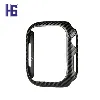
When we think of carbon fiber, words like "lightweight" and "strong" come to mind. But there's a hidden player in its repertoire: thermal conductivity. Unlike metals that shout their heat-handling abilities, carbon fiber whispers a nuanced story-one that's shaped by its atomic structure and design.

At its core, carbon fiber is made of tightly aligned carbon atoms, forming microscopic graphite-like crystals along the fiber's length. This alignment gives it a split personality for heat. Along the fibers, heat zips through like cars on a highway, with thermal conductivity rivaling some metals (up to 1,000 W/m·K in high-grade fibers). But across the fibers, heat moves sluggishly-closer to insulating plastics (as low as 5-10 W/m·K). This directional quirk makes carbon fiber a master of controlled heat flow.
Why does this matter? Imagine a racing car's brake disc. Carbon-carbon composites (reinforced with carbon fiber) excel here because they channel heat along the fibers, preventing warping while resisting heat spread across layers. Similarly, in satellites, carbon fiber panels dissipate heat from electronics along specific paths, avoiding hotspots.

But there's a catch. For everyday uses like phone cases or laptop shells, raw carbon fiber's uneven heat behavior can be tricky. Engineers often blend it with resins or metals to balance conductivity. A carbon-fiber-reinforced polymer might guide heat away from a drone's motor while keeping its shell cool to the touch.
The future? Researchers are tweaking carbon fiber's recipe-adding nanotubes or graphene-to create "designer" thermal properties. One day, your electric car's battery frame might double as a heat sink, all thanks to smart carbon fiber engineering.
In the dance of heat, carbon fiber isn't just a passive partner. It's a choreographer, directing energy exactly where we need it-proving that even the quietest materials can shape our world's temperature.