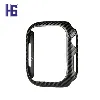
Carbon fiber products are widely used in aerospace, medical devices, rail transit, automotive industries, and more. In practical applications, carbon fiber is typically combined with resin matrices to form carbon fiber composites. Based on resin types, carbon fiber composites are broadly categorized into thermosetting and thermoplastic variants. With the growing development of thermoplastic carbon fiber, here is an overview of thermoplastic carbon fiber materials:

Molding Design Advantages
Thermoplastic carbon fiber composites are easily molded into complex shapes. Thermoplastic resins soften when heated, allowing free shaping in their pliable state, and solidify upon cooling to regain rigidity. Additionally, the diversity of thermoplastic resins enables tailored material formulations to meet specific design and performance requirements, offering flexibility in both geometry and functional properties.
Performance Characteristics
Stability and Corrosion Resistance
While thermoplastic matrices vary widely, most exhibit stable chemical structures, making them resistant to chemical corrosion. Specific formulations can also be customized to enhance corrosion resistance for particular environments.
Fatigue Resistance and Damage Tolerance
Thermoplastic resins possess inherent bonding properties that inhibit crack propagation even if micro-cracks form. The integration of carbon fibers creates numerous internal load-bearing interfaces. If individual fibers fracture, stress is redistributed to intact fibers, preserving structural functionality.
This combination of design flexibility and robust performance positions thermoplastic carbon fiber composites as a versatile solution for high-demand applications.