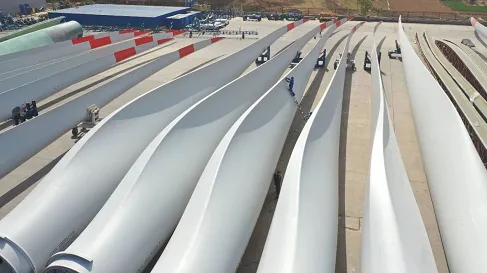
Wind power represents a "green" energy source, generating electricity without pollution while harnessing the inexhaustible power of natural wind. As wind turbines evolve toward higher power outputs, blades are growing longer-for instance, blades for mainstream 1.5MW turbines measure 34–37 meters and weigh approximately 6 tons (fiberglass), posing significant technical challenges.
Currently, most composite blades use glass fiber-reinforced polymer (GFRP) due to lower costs, while carbon fiber-reinforced polymer (CFRP) sees limited adoption despite superior overall performance. A transition period is needed before CFRP becomes mainstream. Nevertheless, carbon fiber composites-with their exceptional properties-stand as an ideal material for wind turbine blades. Their advantages include:
Lightweight & High Strength-to-Weight Ratio
CFRP blades are 30% lighter than GFRP counterparts. This weight reduction cascades to the drivetrain, tower, and platform, lowering the entire system's mass.
Enhanced Rigidity
CFRP offers over twice the rigidity of GFRP. This not only enables optimized pre-bent blade designs but also maintains stable clearance between rotating blades and the tower during operation.
Superior Vibration Damping
CFRP's high damping resistance minimizes spontaneous vibration and accelerates decay after oscillation. This prevents resonance between natural blade frequencies and transient vibrations, ensuring operational stability.
High Fatigue Strength & Longevity
CFRP withstands cyclic stresses from wind turbulence, direction shifts, and gusts, meeting 20-year design life requirements while reducing fatigue fracture risks.
Corrosion Resistance & Environmental Adaptability
Carbon fiber resists acids, alkalis, and salts, making CFRP blades ideal for coastal, saline-alkali, or corrosive environments with long-term durability.