The effect of mold temperature on interfacial bonding strength in the coating and molding process of thermoplastic CF-PAEK (PEEK).
High-performance thermoplastic carbon fiber composites exhibit advantages such as high toughness, impact resistance, low moisture absorption, and excellent environmental performance. Research on this type of composite material has been ongoing, resulting in the development of various thermoplastic carbon fiber composites with different matrices, as well as several feasible processing techniques, including injection molding, compression molding, and coating molding. High-temperature melting technology has long been regarded as one of the primary methods for the preparation of thermoplastic carbon fiber composites. This paper will introduce the effects of mold temperature on interfacial bonding strength for continuous carbon fiber reinforced polyaryl ether ketone (CF-PAEK) and short carbon fiber reinforced polyether ether ketone (CF-PEEK) during the coating molding process, integrating insights from professional literature.
Preparation of Coated Composites from Thermoplastic CF-PAEK and CF-PEEK
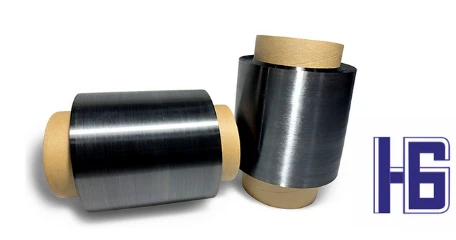
Continuous carbon fiber reinforced thermoplastic polyaryl ether ketone (CF-PAEK) composites were prepared using unidirectional carbon fibers, which were then formed into continuous carbon fiber reinforced composite laminates through compression molding. Polyether ether ketone (PEEK) and short carbon fiber reinforced polyether ether ketone (SCF-PEEK) were chosen as injection materials, injected into molds placed on the surface of the CF-PAEK laminates, and maintained under pressure for a certain period to produce mixed coated composites. After allowing the air to cool to room temperature, the molded thermoplastic carbon fiber composites were removed and cut to fixed sizes. Various performance tests were conducted subsequently, including mechanical property testing, scanning electron microscopy (SEM) analysis, volume fraction testing, rheological behavior testing, and nanoindentation testing. The test data were graphed, and corresponding conclusions were drawn through comparative studies of multiple sample sets.
The effect of mold temperature on the interfacial bonding strength of thermoplastic CF-PAEK (PEEK) composites.
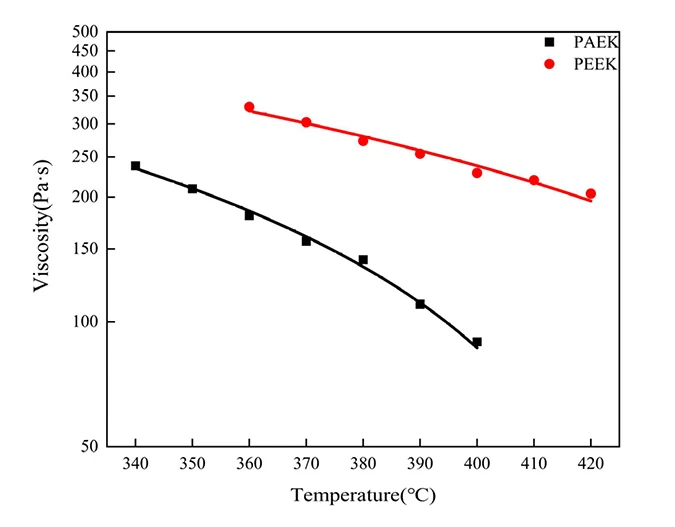
1.Viscosity-Temperature Curves of PAEK and PEEK Resins: The figure above shows the viscosity-temperature curves for PAEK and PEEK resins. The data indicates that the viscosity of PAEK ranges from approximately 89 to 237 Pa·s at temperatures between 340°C and 400°C, while the viscosity of PEEK ranges from 203 to 330 Pa·s at temperatures between 360°C and 420°C. Both thermoplastic resins exhibit shear-thinning behavior, with viscosity decreasing as temperature increases. The lower the viscosity of the resin melt, the better the diffusion, which positively influences interfacial bonding strength.
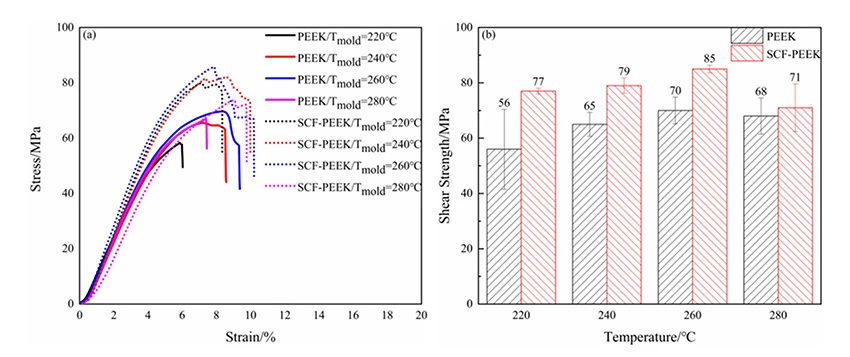
2.Shear Strength of Coated Composites at Different Mold Temperatures: Figure a above shows the stress-strain curves for PEEK and SCF-PEEK materials at different mold temperatures. Figure b presents the shear strength data for PEEK/CCF-PAEK and SCF-PEEK/CCF-PAEK at varying mold temperatures. The shear strengths of PEEK/CCF-PAEK are 56 MPa, 65 MPa, 70 MPa, and 68 MPa, while the shear strengths of SCF-PEEK/CCF-PAEK are 77 MPa, 79 MPa, 85 MPa, and 71 MPa.
The results indicate that as the mold temperature increases, the shear strength of the samples improves. Additionally, due to the reinforcement from short carbon fibers, the shear strength of SCF-PEEK/CCF-PAEK is higher. Mold temperature affects the interface temperature retention time between the injected melt (PEEK and SCF-PEEK) and the CCF-PAEK laminate, as well as the contact time before curing. As the mold temperature rises, the temperature of the interfacial layer gradually increases, promoting the melting and diffusion of PAEK resin at lower melting temperatures, thereby enhancing interfacial bonding strength.
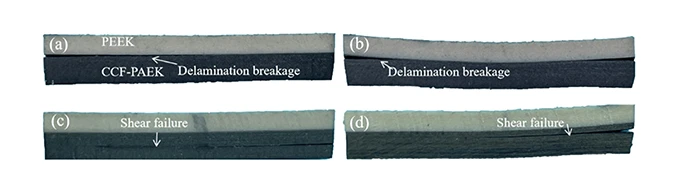
3.Shear Failure Modes of Coated Composite Samples at Different Mold Temperatures: The figure above shows the shear failure cross-sections of PEEK/CCF-PAEK coated composites at different mold temperatures. It reveals that under the action of shear forces, cracks begin to form on both sides of the sample and extend toward the center. When the mold temperature is set at 220°C and 240°C, the failure of PEEK/CCF-PAEK primarily results from interfacial delamination, indicating relatively weak interfacial bonding strength (Figures a and b). In contrast, when the mold temperature increases to 260°C and 280°C, the failure of PEEK/CCF-PAEK is mainly due to interlaminar fracture, suggesting stronger interfacial bonding strength (Figures c and d).
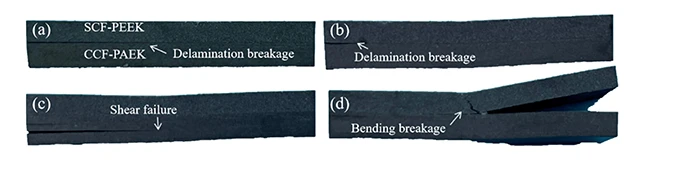
The figure above shows the shear failure cross-sections of SCF-PEEK/CCF-PAEK coated composites at different mold temperatures, with a sample condition similar to that of PEEK/CCF-PAEK composites. At mold temperatures of 220°C and 240°C, interfacial bonding failure remains a major issue (Figures a and b). When the mold temperature increases to 260°C and 280°C, the failure of SCF-PEEK/CCF-PAEK is characterized by interlaminar fracture of CCF-PAEK and bending failure of SCF-PEEK (Figures c and d). Due to the bending deformation and interlaminar shear deformation caused by the coating process, when the interfacial bonding strength weakens, delamination can occur between PEEK, SCF-PEEK, and CCF-PAEK. As the interfacial bonding strength increases, the interfacial delamination in the composite gradually decreases, while interlaminar fracture of the resin increases.
Experimental results indicate that the interfacial failure modes of the composite change with increasing mold temperature. At lower temperatures, the interface temperature is lower, and the melt in the injection mold cools more rapidly, resulting in slower molecular diffusion and weaker adhesion. Shear failure manifests as interfacial failure, characterized by mechanical bonding. As the mold temperature rises, the fracture surface area of PEEK gradually increases. Higher mold temperatures raise the interface temperature between PEEK resin and PAEK, increasing the blending time before curing, which facilitates the melting process of the resin. When the interface temperature exceeds the melting temperature of PAEK, a resin eutectic layer forms at the interface, enhancing the interfacial bonding strength.
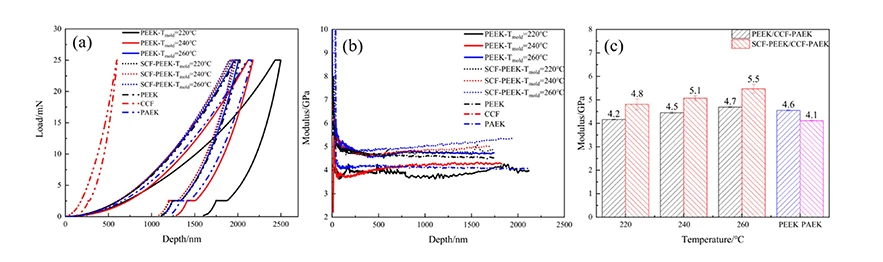
4.Nanoindentation Load-Depth Curves of Coated Composites at Different Mold Temperatures: The curves in the figure above indicate that for the same indentation load, the indentation depth gradually decreases with increasing mold temperature, suggesting that the load-bearing capacity of the resin at the interface strengthens as the mold temperature rises. For the PEEK/CCF-PAEK composite, at a mold temperature of 260°C, the load-bearing capacity of the interface resin is similar to that of PEEK, indicating that the coated composite has reached a state of molten resin mixing with the injection layer resin (PEEK), achieving nearly identical strength. In comparison to PEEK, the SCF-PEEK/CCF-PAEK composite exhibits higher loads at the interface, suggesting that the addition of short carbon fibers enhances the resin at the interface, enabling it to bear higher loads.
When the indentation depth is small, the modulus rapidly decreases with increasing indentation depth (Figure b), showing considerable variation in the modulus curve during this phase. Once the depth exceeds 250 nm, the modulus values begin to smooth out with increasing depth. At depths greater than 500 nm, the modulus curve becomes more stable. At a mold temperature of 220°C, the depth-modulus curve for PEEK/CCF-PAEK coated composites is relatively unstable, with a lower modulus of 4.2 GPa. This indicates that at a mold temperature of 260°C, the melt can form a resin coexistence layer with the surface resin of the preform, resulting in a modulus comparable to that of PEEK.
The depth-modulus curve for SCF-PEEK/CCF-PAEK coated composites is relatively smooth, indicating that the addition of short carbon fibers can enhance the modulus of the resin at the interface. As the mold temperature increases, the modulus also gradually rises. At a mold temperature of 260°C, the increase is significant, reaching up to 5.5 GPa, which is related to the transition in the interfacial bonding state at this temperature. This indicates that the two types of resins at the interface can melt and diffuse into one another. Additionally, short carbon fibers can embed themselves within the interfacial layer when the resin is in a molten state, which contributes to the increase in modulus.