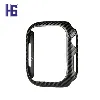
Carbon fiber fabric is a fabric woven from carbon fibers. By making it into a fabric, the material will have an excellent drape and is suitable for 3D shaping. Since the material has an excellent appearance design, there are many demands for appearance uses. It can be used for design purposes and can be stacked in 2 or more directions on 1 layer. It is also a material with high stacking efficiency.

Carbon fiber triaxial fabric is a high-performance composite material with excellent mechanical properties and durability.
Carbon fiber triaxial fabric consists of a first fiber bundle, a second fiber bundle, and a third fiber bundle. Weaving along three axes. Forming a second hexagonal element and a plurality of the first hexagonal elements connected in sequence. Compared with ordinary triaxial fabrics, the intersection points of the triaxial fabric are reduced, and the breaking points of the fibers are greatly reduced, which is more conducive to resin impregnation and increased strength. In addition, the application of carbon fiber triaxial fabric not only improves tear resistance, but also reduces the bending degree of the fiber bundle, reduces deformation, and thus prolongs the service life. The unique structure of this material significantly improves the overall strength and stiffness, has good ablation resistance and damage resistance, and is very suitable for high-energy thermal structural functional materials.
For small aircraft, the parts where carbon fiber materials are widely used are in the wings. The wings must bear the load of the entire aircraft, aerodynamic lift and drag, as well as tension, torque, shear force, etc. These forces act in all directions of the wings. Unidirectional carbon fiber fabrics cannot meet the requirements, and bidirectional fabrics have become the best choice, with reasonable cost and a relatively simple process. Therefore, for small fixed-wing aircraft, the use of a single layer of bidirectional woven carbon fiber cloth in the wing can meet the strength requirements of the wing.

Carbon fiber can be divided into large tows and small tows. According to the number of single filaments contained in each bundle of carbon fiber, K is 1000: commonly used can be divided into 1K, 3K, 12K, 24K, 48K, etc. The more single filaments there are, the greater the weight per unit length, and the corresponding strength will also increase. The weight requirements of small aircraft are very stringent. Due to various reasons such as limited battery capacity and more mission load, the flight performance may be greatly improved for every gram of weight reduction. Therefore, a major mission of composite materials in small aircraft is to reduce weight.

Standard carbon fiber fabric
| Weave | Raw yarn horizontal vertical |
Density(pieces/size) horizontal vertical |
Weight (g/m²) |
Thickness (mm) |
Standard Width (mm) |
Standard Length (m) |
||
| Plain weave | TR 30S 3L | TR 30S 3L | 12.5 | 12.5 | 200 | 0.23 | 1,000 | 100 |
| 2/2 twill | TR 30S 3L | TR 30S 3L | 12.5 | 12.5 | 200 | 0.21 | 1,000 | 100 |
| Plain weave | TR 50S 6L | TR 50S 6L | 9.0 | 9.0 | 288 | 0.32 | 1,000 | 100 |
| Plain weave | TR 50S 6L | TR 50S 6L | 11.0 | 11.0 | 350 | 0.39 | 1,000 | 100 |
| Plain weave | TR 50S12L | TR 50S12L | 6.3 | 6.3 | 400 | 0.46 | 1,000 | 50 |
| 2/2 twill | TR 50S12L | TR 50S12L | 10.0 | 10.0 | 646 | 0.57 | 1,000 | 50 |