Required Materials
01
Reinforcement material
The reinforcement material for winding is carbon fiber yarn of various specifications, including 1k, 3k, 6k, 12k, etc.
02
Resin matrix
Commonly used resins in the winding process include unsaturated polyester resin, epoxy resin, and bismaleimide resin. Unsaturated polyester resin is mainly used in civilian industries, such as manufacturing carbon fiber tubes, carbon fiber tanks, etc. Epoxy resin has better performance and is used to make products with high requirements for strength and tensile modulus. Bismaleimide resin has the most outstanding performance and is mainly used to make grade carbon fiber products. The role of resin is very large, and a large part of the chemical and physical properties of winding products depend on it.
03
Filler
After adding filler, some functions of resin will be improved. For example, adding hollow glass microspheres will reduce the density and weight of the product, but increase the rigidity. Rigidity can also be increased by adding an appropriate amount of quartz sand. Other materials can also be added to improve wear resistance, flame retardancy, etc.
Production
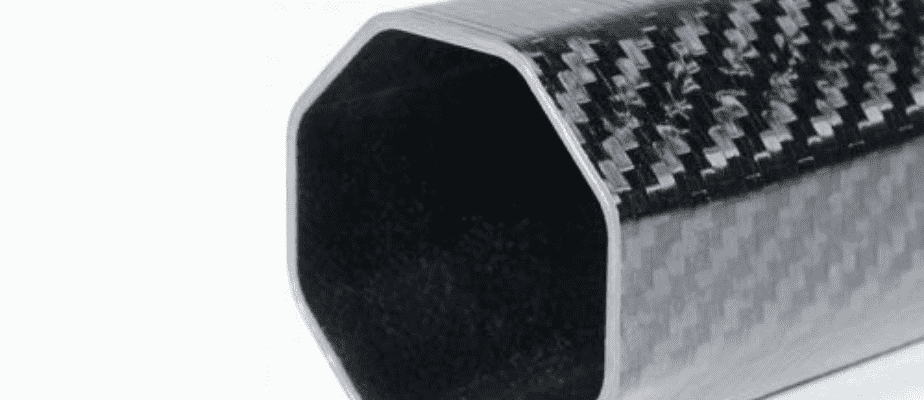
Tensioning The tow roll is usually tensioned by a mechanical device, which will vary according to the design of the process. Many forms of tensioning involve springs to create friction through the free rotation of rollers to hold the filaments tight against the tooling to which they are applied. In our experience, it is best to keep the tensioning method as simple as possible to reduce process variation. Tension can be applied on the rollers or by a separate device and is applied by combing, resin application, rolling, and placing the tow on the mandrel. Tension ensures process stability and repeatability and is often an important measure of quality as it is a means of consistency and control of the process as the tow is compacted onto the mandrel.
Combing for uniformity
The carbon fiber tow is then passed through a combing or separation device that helps to make the raw filaments uniform before the tow is introduced into the resin bath. The separation device can be described as a comb and its importance is that it brings fiber uniformity in tension control as the tow is immersed in the resin bath. As the tow passes through the resin bath, it is combed again to remove excess resin from the tow.
The tow can then be flattened using a "nip roll" as needed to provide additional fiber uniformity before being directed onto the "mandrel".
Direction Control
"Direction" is arguably the most important part of the carbon fiber winding machine process. When the combed, resin-soaked, and wound fibers are all gathered together, the head is responsible for providing fiber orientation and moving from one side to the other as the tow application speed is provided in the circular motion of the mandrel. The two synchronized mechanical functions ensure that the critical fiber direction is met and the tow is properly placed as required by the part design. Once the winding is completed, the part can be cured and then it can be peeled off the mandrel surface.
The advantages of wet winding are as follows
The product has good air tightness because the winding tension causes the excess resin glue to squeeze out the bubbles and fill the gaps
01
The cost is 40% lower than dry winding
02
During wet winding, the resin glue on the fiber can reduce fiber wear
03
The fiber arrangement is parallel
04
High production efficiency (up to 200m/min)
05
Production steps
Preparation
This stage includes material selection and preparation. Carbon fiber prepreg is usually carbon fiber yarn that has been pre-impregnated with resin for subsequent winding. A mold, usually a metal or composite mold, needs to be prepared to allow the carbon fiber to be wound onto it.
Fiber Winding
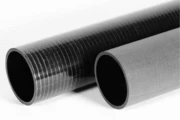
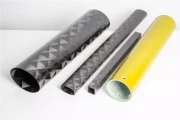
At this stage, the carbon fiber yarn is wound onto the mold to form a tubular structure. This process generally involves two main winding methods: axial winding and hoop winding. Axial winding is winding the carbon fiber parallel to the axis of the tube, while hoop winding is winding the carbon fiber around the axis of the tube at different angles.
Curing
After winding, the tube needs to be cured. This generally involves heating the tube to cure the resin. The temperature and time vary depending on the type of resin used and the process specifications.
Post-processing
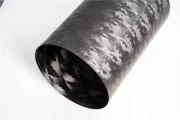
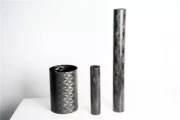
After curing, the tube may require post-processing such as trimming, cutting, and grinding to meet the final specifications and surface quality requirements.
Inspection and Testing
The finished tube usually needs to undergo quality control and testing to ensure that it meets the required strength, stiffness, and other performance indicators.
Application
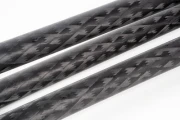
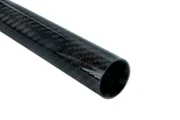
The finished carbon fiber wound tube can be used in various applications such as aerospace, automotive engineering, sports equipment, etc.