


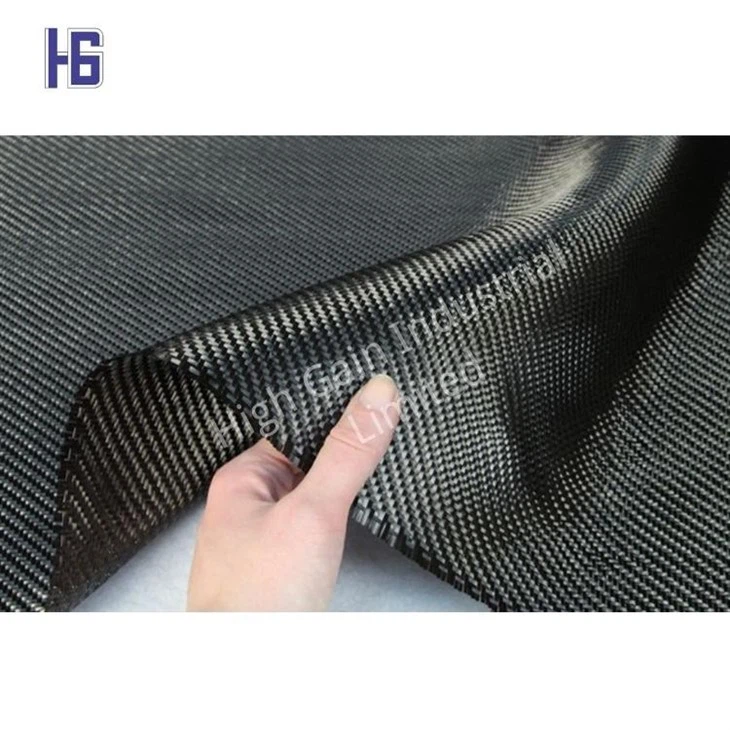

Carbon Fiber Fabric Roll
Carbon Fiber Fabric Roll
Product Description
Carbon Fiber Fabric Roll is a composite material known for its exceptional strength, low weight, and versatility. It is widely used in various industries due to its unique characteristics and numerous advantages. In this article, we will delve into the manufacturing process, structural properties, applications, and notable examples of woven carbon fiber.

The twill weave pattern is defined by a diagonal design achieved through a method of crossing threads. This can be depicted as either 2 × 2 or 4 × 4. Fundamentally, in twill weave, every thread passes under two other threads and then emerges over two other threads. Likewise, in 4x4 twill fabric, each thread passes under four other threads and then emerges over four other threads.

Advantages of Carbon Fiber Fabric Roll
Carbon fiber fabric roll offers several advantages that make it an appealing choice for a wide range of applications:
1.High Strength-to-Weight Ratio: Carbon fiber fabric roll is exceptionally strong while being significantly lighter than metals such as steel and aluminum. This characteristic makes it ideal for applications where weight reduction is critical without compromising structural integrity.
2.Stiffness and Rigidity: Carbon fiber composites exhibit high stiffness and rigidity, providing excellent resistance to deformation under load. This makes them suitable for applications requiring precise dimensional stability and minimal flexing.
3.Corrosion Resistance: Unlike metals, carbon fiber is not susceptible to corrosion, making it an excellent choice for components subjected to harsh environmental conditions.
4.Fatigue Resistance: Carbon fiber fabric roll exhibits exceptional fatigue resistance, making it suitable for components subjected to repeated loading cycles.
Design Flexibility: Carbon fiber can be molded into complex shapes, allowing for the creation of intricate and aerodynamic designs that would be challenging to achieve with traditional materials.

Manufacturing Process
Surface Treatment: The carbon fibers undergo surface treatment to enhance their bonding properties and compatibility with various resin systems.
Weaving: The carbon fibers are woven into fabric using specialized looms, creating the characteristic woven pattern that provides strength and reinforcement to the final composite structure.
Resin Infusion: The carbon fiber fabric roll fabric is then impregnated with a resin matrix, typically epoxy, through processes such as vacuum infusion or resin transfer molding.
Curing: The resin is cured, creating a solid composite material with the carbon fibers providing the structural reinforcement.

Conclusion
The outstanding strength-to-weight ratio, stiffness, corrosion resistance, and design adaptability of carbon fiber fabric roll make it a highly valuable material for diverse industries. With ongoing advancements in technology and manufacturing, carbon fiber composites are anticipated to have a growing impact in facilitating creative and eco-friendly solutions in engineering and design. Ultimately, the distinctive characteristics and broad applicability of woven carbon fiber firmly establish it as a revolutionary material in contemporary industry, fueling progress in performance, effectiveness, and environmental responsibility.

Hot Tags: carbon fiber fabric roll, China carbon fiber fabric roll manufacturers, suppliers, factory, 3K fabric, carbon fiber prosthetic hand, Composite Jacquard Fabrics, Adhesive Teflon Film, carbon fibre bottle rack, PET film plastic
Previous
Plain Carbon FiberYou Might Also Like



Send Inquiry