Japan's Mitsui Chemicals has teamed up with a microwave technology company to create a new way to make carbon fiber. It's called "Innovative Environmentally Friendly Carbon Fiber Manufacturing Technology Using Microwaves." The process uses microwaves to heat the oxidation and carbonization stages of polyacrylonitrile (PAN) fibers.
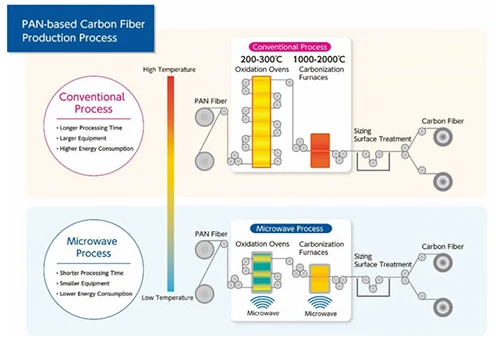
How it works?
Traditional methods:
Old school carbon fiber production uses oxidation furnaces at 200°C to 300°C and carbonization furnaces at 1,000°C to 2,000°C. These furnaces heat everything indirectly.
Microwave process:
The new process uses smaller equipment and is much more efficient. It reduces energy consumption by about 50% and is much faster. Microwaves heat the PAN fibers directly and specifically, making it more effective than the old indirect heating methods.
Why Microwaves Win?
Energy savings: Microwaves heat fibers directly, wasting less energy. This makes production more environmentally friendly and cost effective.
Faster: Faster heating reduces oxidation and carbonization time, increasing overall efficiency.
Compact: Microwave technology means smaller, better equipment that saves space in factories.
Precise heating: Microwaves target PAN fibers precisely, distributing heat evenly without heating the entire furnace.
This microwave process is a big step forward for carbon fiber production. With better technology, the industry can be more sustainable, reduce costs, and improve performance. This could change the way high-performance carbon fibers are made, making them more accessible and better for the environment.