Ultrasonic vibration-assisted machining (UVAM) is an emerging advanced manufacturing technology that has recently attracted research interest globally for processing carbon fiber composites. This technique offers significant advantages, including reduced cutting forces, minimized tool wear, and improved machining quality, making it particularly suitable for hard, brittle, and difficult-to-machine materials like carbon fiber. Below is a brief introduction to UVAM for carbon fiber composites.
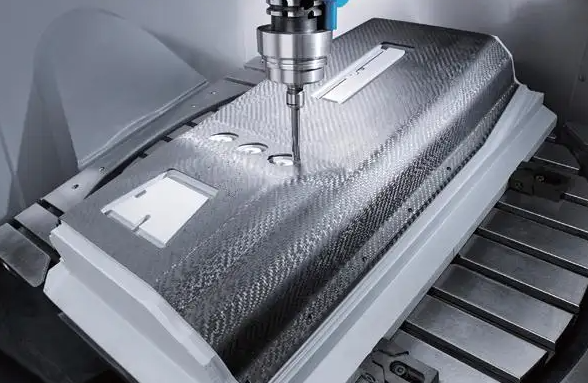
Conventional machining of carbon fiber composites often results in defects such as delamination, tearing, burring, and fraying, along with challenges of low precision and high processing difficulty. Systematic ultrasonic vibration experiments demonstrate that UVAM substantially enhances machining accuracy and efficiency. Components processed with UVAM achieve stable surface roughness values between Ra 0.9 and 2.5 μm, significantly improving surface quality compared to conventional cutting. Optimizing ultrasonic frequency and amplitude while reducing cutting depth and feed rate further minimizes defects in composite machining.
A UVAM system for carbon fiber primarily consists of an ultrasonic power supply unit, energy transmission system, transducer, and ultrasonic horn. By superimposing ultrasonic vibrations onto the cutting tool-either tangentially along the workpiece rotation direction or parallel to the feed direction-on a conventional lathe, surface quality is markedly improved. This approach reduces tool wear by 30%, decreases workpiece surface roughness by 25–50%, and enhances roundness by 40–50%.