Will thermoplastic carbon fiber improve the production and processing of hydrogen storage bottles in the future?
Hydrogen energy is widely recognized as one of the most environmentally friendly energy sources. Research on hydrogen has a history of over a hundred years, and its application as a clean energy source has been studied for several decades. Due to hydrogen's flammability and explosiveness, there are high requirements for temperature and pressure in its usage scenarios. Therefore, more in-depth research and experiments are needed to enable more convenient use of hydrogen energy. Hydrogen storage bottles are currently a relatively successful method for applying hydrogen energy; they can store high-pressure hydrogen gas and are used in vehicles such as cars. Over the decades, hydrogen storage bottles have evolved from Type I to Type V, transitioning from all-metal materials to completely wound composite materials without an interior liner.
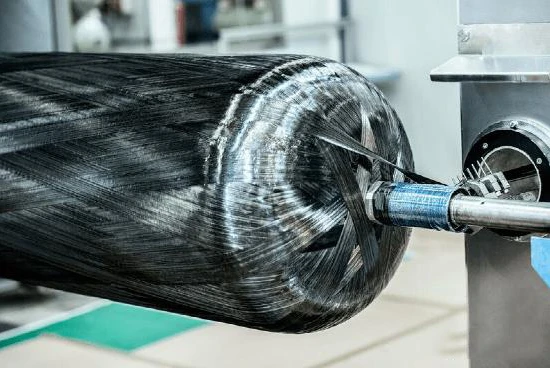
The performance advantages of carbon fiber hydrogen storage bottles are significant, and they can be used simultaneously with aramid fibers.
Recently, the Indian Institute of Aerospace Engineering released a research finding that compared and analyzed the structural behavior of Type IV high-pressure hydrogen storage bottles made from S-glass fiber, T700-grade carbon fiber, and aramid fiber-reinforced composites under a working pressure of 70 MPa.
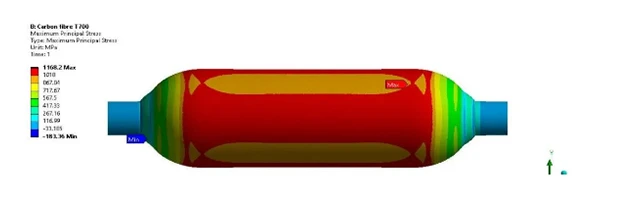
The results showed that the deformation of the S-glass fiber Type IV bottle was 10.873 mm, the deformation of the T700-grade carbon fiber Type IV bottle was 10.176 mm, and the deformation of the Kevlar Type IV bottle was 1.0845 mm. The elastic strains for the three materials were 0.26812, 0.25658, and 0.073177, respectively. Additionally, the maximum principal stress for the S-glass fiber Type IV bottle was 1105.9 MPa, the stress for the carbon fiber Type IV bottle was 1168.2 MPa, and the stress for the Kevlar Type IV bottle was 1389.4 MPa. The study pointed out that within acceptable ranges of stress and strain, aramid fibers are suitable materials for hydrogen pressure vessels.
In summary, in the application of composite material hydrogen storage bottles, carbon fiber composites offer higher stiffness, while aramid fiber composites provide better toughness. Of course, these two types of composites are not mutually exclusive; rather, through reasonable design and combination, their respective advantages can be leveraged. This approach can balance stiffness and toughness in carbon fiber hydrogen storage bottle applications, ensuring mechanical performance while enhancing safety.
Can carbon fiber hydrogen storage bottles reverse the decline in the value of "black gold"?
Carbon fiber is known as "black gold," reflecting its high value, and correspondingly, market prices have remained elevated. However, statistics from the past two years indicate that "black gold" is depreciating. Those in related industries or carbon fiber professionals should understand the reasons behind this trend. There has been a surge in low-end carbon fiber production capacity, while demand from downstream industries has reached saturation. The consequence of oversupply is a rapid decline in carbon fiber market prices. Of course, the increase in production capacity for mid- to high-end carbon fibers and composites has not been significant, and market prices have not changed much.
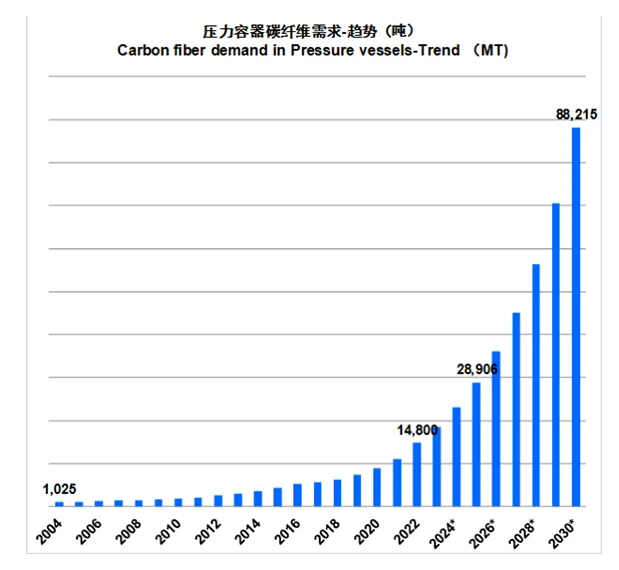
Data shows that in 2022, the global carbon fiber market size reached $4.386 billion, a year-on-year increase of 29.0%. Global demand for carbon fiber was 135,000 tons, growing by 14.4% compared to 118,000 tons in 2021. Driven by the "dual carbon" policy, the pressure vessel market has experienced rapid growth, with global demand for pressure vessels reaching 14,800 tons in 2022, an increase of 34.5% from the previous year, accounting for 11.0% of the segmented market. It is expected that by 2030, global demand for pressure vessels will exceed 80,000 tons, indicating a strong growth trend.
In 2022, China used approximately 6,000 tons of carbon fiber for gas cylinders, with nearly half of that used for hydrogen storage bottles. In the future, the growth point for carbon fiber in pressure vessels is likely to emerge from the hydrogen storage bottle market. With the government's strong push for the development of hydrogen fuel cells and vehicles, there is immense potential in the hydrogen storage bottle sector, leading to accelerated demand for carbon fiber in this field. Data indicates that by the end of 2022, the number of hydrogen fuel cell vehicles in China was approximately 12,300, with a target of reaching 50,000 by 2025, resulting in an annual compound growth rate of nearly 60%. If the carbon fiber demand for hydrogen storage bottles increases to 50% by 2025, the demand for carbon fiber could reach 12,700 tons.
In the coming years, the potential for carbon fiber hydrogen storage bottles is enormous. Targeted low-end carbon fiber production capacity not only mitigates the decline in the value of "black gold" but also promotes the rapid development of the hydrogen energy industry, achieving a true win-win situation.
Will thermoplastic carbon fiber improve the production and processing of hydrogen storage bottles in the future?
The release of low-end carbon fiber production capacity is expected to help resolve the challenges faced by the domestic carbon fiber industry, but this is not a long-term solution. A more comprehensive enhancement of carbon fiber technology-specifically mastering the mass production capabilities of mid- to high-end carbon fibers-is essential for gaining a competitive edge in the global carbon fiber market. Thermoplastic carbon fiber could be the next important direction for the development of the carbon fiber industry. So, will thermoplastic carbon fiber composites play a promoting role in hydrogen energy utilization?
Advantages of thermoplastic carbon fiber composites:
1.High Strength-to-Weight Ratio: Carbon fiber is renowned for its high strength-to-weight ratio. Combining carbon fiber with a thermoplastic matrix enhances this advantage, making thermoplastic carbon fiber composites attractive for applications in aerospace and automotive industries where lightweight materials and high strength are critical.
2.Chemical Stability: Thermoplastic resins typically exhibit better chemical resistance compared to thermosetting resins, making thermoplastic carbon fiber composites suitable for applications that require contact with aggressive chemicals, such as those in the chemical processing industry.
3.Improved Impact Resistance: Compared to thermosetting resins, thermoplastic resins often have better impact resistance and toughness, which makes thermoplastic carbon fiber composites ideal for applications requiring excellent impact performance.
4.Fast Manufacturing: The processing speed of thermoplastic carbon fiber composites is faster than that of thermosetting carbon fiber composites due to shorter curing times. This characteristic benefits industries that demand quick production cycles and high throughput.
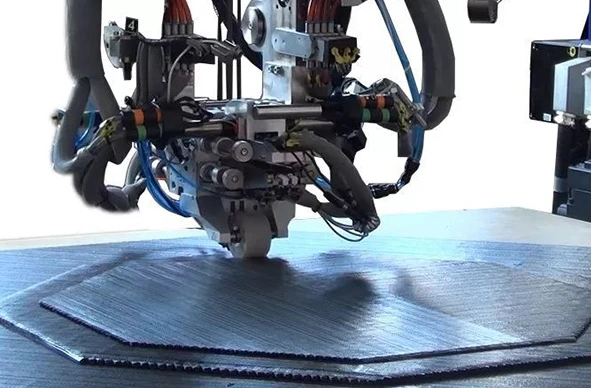
5.Weldability: Thermoplastic carbon fiber composites can be joined using various welding techniques, such as ultrasonic welding or induction welding. This capability facilitates the assembly process and allows for the production of complex structures.
6.Repairability: Thermoplastic carbon fiber composites are generally easier to repair than thermosetting carbon fiber composites. They can be heated, reshaped, or patched, enabling on-site repairs without compromising the overall performance of the material.
7.Reprocessability: Thermoplastic carbon fiber composites can be melted and reformed multiple times without significantly degrading their mechanical properties. In contrast to thermosetting carbon fiber composites, which undergo irreversible curing reactions, this reprocessability makes thermoplastic composites more environmentally friendly and economically viable.
8.Recyclability: Thermoplastic carbon fiber composites can be recycled at the end of their lifecycle, reducing environmental impact and contributing to sustainable usage.