American company Rocket Lab is developing the world's largest carbon fiber composite "Neutron" rocket.
The Neutron medium-lift rocket from American Rocket Lab has made innovative advancements in space travel, becoming the largest composite rocket ever manufactured to date. Initially, hundreds of layers and thousands of square feet of carbon fiber were manually laid onto a mold, with a large team spending weeks to complete the task.

Now, the 39-foot-tall carbon composite 3D printer can lay down 328 feet of carbon fiber per minute, thanks to Rocket Lab's new automated fiber placement (AFP) machine, which can complete the task in a single day.
You can think of it as a 39-foot (12-meter) tall, 75-ton autonomous 3D printer that can print carbon fiber layers at a speed of 328 feet (100 meters) per minute. It doesn't "print" parts; instead, it lays down sheets of carbon fiber layer by layer in different directions to enhance the strength and stiffness of each structure. The AFP has a lateral movement capability of up to 98 feet (30 meters), making it fully capable of laying down the largest components-such as the 91-foot (28-meter) long stages and fairings of the Neutron rocket.
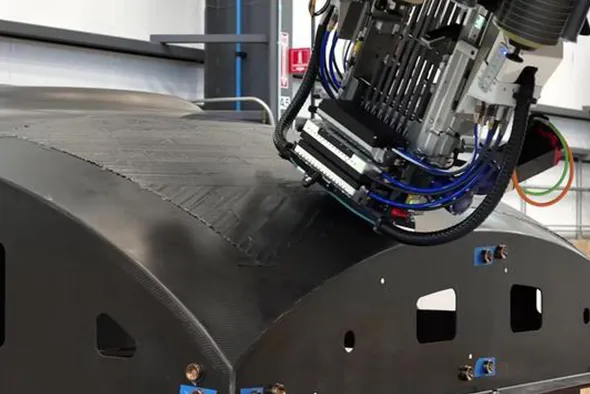
The AFP is also responsible for layering the fuel tanks of the first stage, which has a diameter of 22.9 feet (7 meters), and the second stage, which has a diameter of 16.4 feet (5 meters).
During the processing of components, the built-in fully automated inspection system scans for defects or flaws in the carbon composite structure and pauses before proceeding to the next layer, alerting the operator to any issues.
SpaceX's Starship is primarily made of stainless steel (300 series "HFS," similar to the "bulletproof" material used in the Cybertruck), while Boeing's Starliner mainly uses aluminum alloys. Initially, SpaceX considered using CF composites for the Starship, but ultimately opted for stainless steel due to its cost-effectiveness, temperature resistance, and durability.

Rocket Lab expects that the use of AFP will reduce the construction costs of the world's largest reusable composite rocket, while also increasing production speed and ease, ultimately saving over 150,000 man-hours.
According to Rocket Lab's website, the company's goal is to launch the first Neutron rocket in 2025.