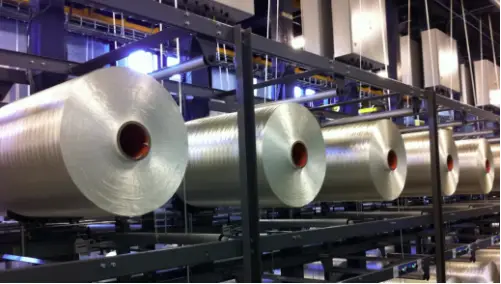
Recently, UK-based Cygnet Texkimp has officially launched the world's first Very Heavy Duty (VHD) creel system compatible with 500kg fiber rolls, breaking the 350kg tow roll weight ceiling that has prevailed in the carbon fiber industry for years.
This fundamental technological breakthrough in equipment boosts the effective weight of each single tow roll by over 40%. Meanwhile, under equivalent production capacity, roll change frequency is cut by roughly 30%, and the continuous operation time of production lines is extended by more than 40%.Against a backdrop of surging demand for carbon fiber across global wind turbine blades, hydrogen storage tanks, new energy vehicles and other sectors, this milestone signals that carbon fiber production has entered a new era featuring high-efficiency, low-cost continuous manufacturing and large-tow technology.
As a core front-end piece of equipment for carbon fiber production, the performance of creels directly dictates the continuous running capacity of production lines and the quality of finished products.In the past, constrained by limitations in tension control and loading/unloading technologies, frequent downtime for roll changes not only drove up labor and maintenance costs but also tended to cause fluctuations in fiber tension, raising risks of filament breakage and inconsistent product performance.The launch of this 500kg jumbo roll solution integrates industry-leading electronic tension control systems and closed-loop floating guide rod mechanisms. It maintains nearly constant fiber tension during high-speed unwinding, fundamentally ensuring consistent product quality under the large-spool production model. In addition, the equipment supports customized highly automated configurations, perfectly aligning with the global trend of building self-reliant and controllable carbon fiber supply chains. It delivers core hardware support to accelerate the commissioning of new production capacities.
From the perspective of downstream product manufacturers, we believe the sharp improvement in production efficiency and substantial cost reduction at the upstream production side will be directly passed on to raw material supply, delivering more stable and cost-effective carbon fiber resources for end-use applications.Faced with this industrial transformation, product manufacturers should take proactive precautions. On one hand, they need to closely monitor performance variations of upstream large-tow carbon fiber tow and optimize their prepreg manufacturing and forming processes in advance. On the other hand, closer technical collaboration with upstream suppliers is required to convert upstream cost-saving benefits into market competitiveness of end products, and jointly drive the wider adoption of carbon fiber across more civil sectors.