


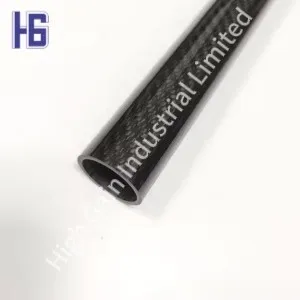
Carbon Fiber Fabric Tube
Common uses include:
· Automated robots
· Telescopic rods
· Meters
· UAVs
· Astronomical telescopes
· Musical instruments
· Industrial machinery
· Aerospace
· Racing car components
Carbon fiber fabric tube is usually not used alone but is processed into fabrics, tapes, paper, etc., and added to materials such as resins and metals as reinforcing materials to form composite materials. Carbon fiber fabric is an important application form of carbon fiber. According to the orientation of the yarns in the carbon fiber fabric, carbon fiber fabric can be divided into unidirectional fabric, bidirectional fabric, and multi-axial fabric, and the main application forms are divided into two categories: dipped and non-dipped.

For small aircraft, the wing must bear the load of the entire aircraft, aerodynamic lift, drag and withstand tension, torque, shear, and other stresses. Unidirectional carbon fiber fabric cannot meet these requirements. Bidirectional fabric is the best choice for carbon fiber wings, with reasonable cost and a relatively simple process.

Carbon fiber fabric tube is also divided into large tow and small tow. Small aircraft have strict weight requirements, limited battery capacity, and other reasons. Every gram of weight reduction may greatly improve flight performance. The most prominent mission of composite materials in improving the performance of small aircraft is weight reduction.

Carbon fiber wound tubes are usually the hardest, followed by fabric tubes, while unidirectional tubes have relatively low hardness.
· Carbon fiber wound tubes: This manufacturing method allows the carbon fiber to be evenly distributed on the tube wall, providing excellent stiffness and strength. Carbon fiber wound tubes have high stiffness and high strength and are suitable for applications that need to withstand large loads.

· Fabric tubes: The fiber direction of carbon fiber fabrics can be multi-directional, and compared with unidirectional tubes, it has higher bending and interlayer stiffness. Fabric tubes are softer than unidirectional tubes and have higher stiffness and strength.

· Unidirectional tubes: Due to the limitation of fiber direction, unidirectional tubes have lower stiffness than fabric tubes and carbon fiber wound tubes. Unidirectional tubes also have higher strength and stiffness, which can meet the requirements of many applications.

Advantages
Stiffness: Unidirectional rods and tubes have a higher stiffness-to-weight ratio than twill rods and tubes because the fibers are laid flat and face the same direction.
Cost: Unidirectional carbon fiber fabric tube is generally used in structural applications is easier to manufacture than twill carbon fiber and is the cheapest
Customization: Unidirectional fabrics can be laid in a variety of different directions, and the characteristics of the tube can be efficiently matched to the end-use goals.
Hot Tags: carbon fiber fabric tube, China carbon fiber fabric tube manufacturers, suppliers, factory, plain carbon fiber prepreg, carbon badminton rackets, peel ply cloth, carbon fiber paddle blade, Carbon Fiber Filament Winding Arrow, Composite Jacquard Fabrics
Previous
Long Carbon Fiber TubesYou Might Also Like


Send Inquiry