Carbon fiber structural batteries are expected to increase the driving range of electric vehicles by 70% in the future.
When cars, airplanes, ships, or computers are made using a material that functions both as a battery and a load-bearing structure, their weight and energy consumption can be significantly reduced. According to a paper published on the 10th in the latest issue of Advanced Materials, a research team from Chalmers University of Technology in Sweden has made progress in "massless energy storage" by developing a multifunctional carbon fiber structural battery. This battery can reduce the weight of laptops by half, make smartphones as thin as credit cards, or increase the driving range of electric vehicles by 70% on a single charge.
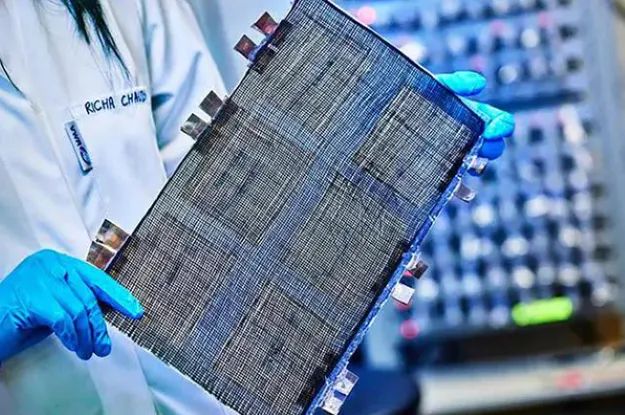
Chalmers University of Technology researcher Rika Chaudhuri stated that the structural battery they developed is made from carbon fiber composite materials, which have a stiffness comparable to aluminum and an energy density sufficient for commercial applications. A structural battery is a material that can both store energy and bear loads. Integrating battery materials into the actual construction of products means that electric vehicles, drones, handheld tools, laptops, and smartphones can achieve a lighter weight.
In 2018, the team first demonstrated that carbon fiber, which possesses high rigidity and hardness, can chemically store electrical energy and function as an electrode in lithium-ion batteries. This research garnered widespread attention and was recognized by Physics World as one of the top ten breakthroughs of that year.
Since then, the research team has further developed their concept, enhancing the battery's stiffness and energy density. In 2021, they increased the energy density to 24 watt-hours per kilogram (Wh/kg), which is about 20% of the capacity of comparable lithium-ion batteries. Now, they have raised the energy density to 30 Wh/kg. Although this is still lower than currently common batteries, the impact is significantly different. When batteries become part of the structure and can be made from lightweight materials, the overall vehicle weight can be greatly reduced. As a result, the energy required for electric vehicles would decrease substantially.

Researchers conducted calculations on electric vehicles and found that if equipped with the new structural battery, the driving range could increase by up to 70% compared to current levels. The stiffness of the structural battery units has also significantly improved, with the elastic modulus measured in gigapascals (GPa) rising from 25 to 70. This means that the material can bear loads like aluminum but is lighter in weight.
The researchers stated that from a multifunctionality perspective, the performance of the new battery is twice that of the previous generation, making it the best battery in the world to date. However, before the battery cells can transition from small-scale laboratory production to large-scale manufacturing and application in technological products or vehicles, a significant amount of engineering work still needs to be done.