The use of carbon fiber materials in domestic civil aviation aircraft is on the rise.
ARJ21 Airliner
The composite application of the ARJ21 airliner accounts for only 2% of the airframe. Application parts include the rudder, wingtip winglets, flaps and fairings.
The carbon fiber used is T300 grade, and the production process is the traditional hand lay-up, vacuum bag hot-pressing tank forming and curing for many times.
C919 Airliner
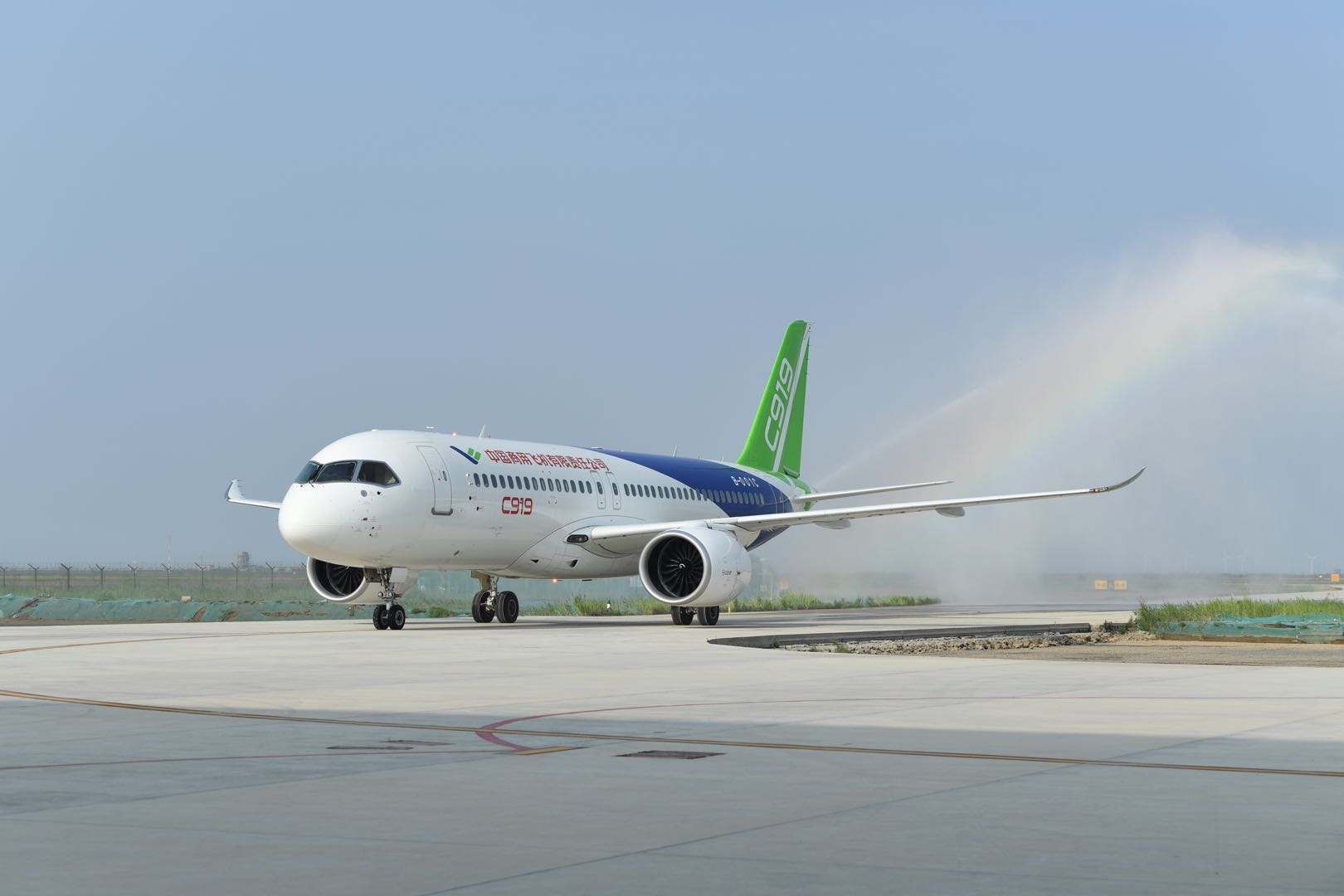
In the production of C919 airliner, the application of composite materials has been increased to 12%. The parts include drogue, flat tail, rear fuselage, radome, hatches, ailerons and spoilers.
The carbon fiber used is T300 grade and T800 grade, and the manufacturing method has been upgraded to a modern process of automatic tape lay-up and hot membrane molding.
Advantages of Carbon Fiber
Modern commercial aircraft are designed to save fuel and increase range by reducing their own structural weight. Carbon fiber composites have become an ideal alternative for aircraft construction due to their lower density (only 3/5 that of aluminum) and higher strength than aluminum alloys.
Carbon fiber is very fine, with a fiber diameter of 5-7 microns, only one-tenth the diameter of a human hair. It is made from polypropylene cyanide fibers, viscose fibers and asphalt fibers by high-temperature carbonization, with a carbon content of over 92%.
Carbon fiber is divided into large tow fiber and small tow fiber. Small tow fiber has a more difficult production process and higher cost, mainly used in aerospace manufacturing.
Development of China's Carbon Fiber Industry
In the 1980s, China's carbon fiber production equipment and technology were very backward, and domestic demand for carbon fiber was mainly met by imports from the United States and Japan, which were expensive and uncertain in supply.
With continuous national investment in basic materials research, the development of carbon fiber was included in the national "863" program.
In 2005, China achieved a breakthrough in the core technology of T300-level carbon fiber, becoming the third country after the United States and Japan to mass-produce high-performance carbon fiber.
By 2021, China was able to mass-produce T300, T700, T800 and T1000 level carbon fiber with an annual output of 63,400 tons, accounting for 30.5% of the world's output. This made China the world's largest carbon fiber producer. Carbon fiber prices have dropped sharply due to competition in China, with T700 carbon fiber dropping to one-third of its original price, and T800 and T1000 high-performance carbon fiber dropping to one-tenth of its original price.
Future Prospects
The development of China's carbon fiber manufacturing industry has laid a good foundation for the application of carbon fiber composites in domestic civil aircraft. The composite application ratio of the CRC929 long-haul wide-body aircraft in the R&D center will be more than 51%, with the entire fuselage, wings and tail (except for the nose) made of carbon fiber composites. This will reach the composite application ratio of the Airbus A350 and Boeing 787, making the CR929 a civil airliner that is truly at the world's leading manufacturing level.