In the realm of composite materials, the efficient and environmentally friendly recycling of continuous carbon fibers has long posed a significant challenge. Researchers at the Fraunhofer Institute for High-Speed Dynamics (EMI) recently announced a groundbreaking technology that utilizes high-power lasers to recover continuous carbon fibers from fiber-reinforced polymers (FRPs) without damaging their structural integrity. This advancement marks a major leap in carbon fiber recycling and unlocks new possibilities for industrial applications.
Unlike conventional recycling methods, which typically involve shredding composite materials and thereby shortening carbon fibers while compromising their performance, Fraunhofer EMI's technique employs high-power lasers to locally degrade the polymer matrix in multilayer fiber-reinforced polymers under high-temperature conditions. This approach preserves the fibers' original length and strength while offering substantial ecological and economic benefits. Project Manager Mathieu Imbert explains, "We simultaneously achieve pyrolysis of the matrix and release of the fibers at a viable rate, without harming the carbon fibers."
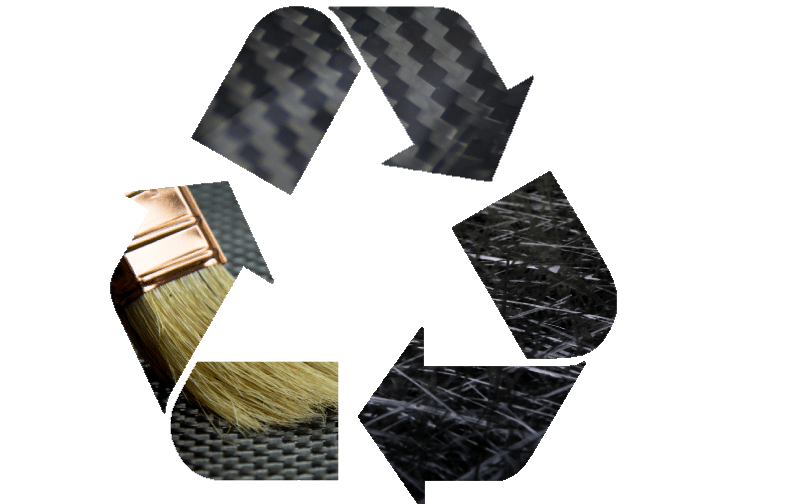
The technology is particularly suited for recovering continuous carbon fibers from complex structures such as pressurized hydrogen tanks, where fibers are wound around plastic liners to enable the tanks to withstand service pressures of up to 700 bar. By precisely controlling temperature, researchers can remove the thermoset matrix without damaging the fibers, ensuring that the recycled fibers retain performance characteristics equivalent to new ones.
While challenges remain-such as determining the optimal process window, given that thermoset matrix degradation occurs between 300°C and 600°C, while fibers risk damage near 600°C-Imbert emphasizes, "We have struck a strong balance between process efficiency and the quality of recycled materials." Additionally, since heat is applied only locally and fibers can be continuously recovered, thick-walled hydrogen tanks no longer require lengthy pyrolysis processes or high costs. Notably, this laser-assisted recycling method consumes just one-fifth of the energy needed to produce new fibers-a critical advantage amid rising energy costs and growing environmental demands.
As global emphasis on sustainability intensifies, thermoplastic carbon fiber composites are gaining widespread attention for their superior recyclability. Leading industry player Zhishang New Materials is actively exploring and developing similar advanced recycling technologies and high-performance composites. Through continuous innovation, the company aims to enhance material circularity, reduce resource waste, and drive the development of green manufacturing. Currently, Zhishang is deeply engaged in R&D projects focused on delivering more eco-friendly and efficient carbon fiber composite solutions for markets in China and beyond.
Looking ahead, the advancement of such initiatives promises to unlock the unique potential of carbon fiber composites across diverse industries, collectively paving the way for a greener and more efficient future.